Thursday, February 27, 2014

Who Moved My Cheese? How the Superconsumer & Rapid Experimentation Drive Revenue

Testing and learning with your passionate brand loyalists can open up new product insights and increase revenue.  Rapid Experimentation provides a framework for engaging with your superconsumers to learn and drive innovation and revenue.

So what is a "superconsumer" and how do you unleash their power?

Superconsumers are different than high volume/heavy users.  The super consumer combines big spending with high brand engagement. 


Here’s an example:


A recent article published in the Harvard Business Review highlights how Kraft's Velveeta Cheese brand leveraged the power of their superconsumers.  The Velveeta superconsumers were the people using the cheese product beyond the twice a year super bowl  fiesta nacho dip and holiday time cheesy beef on toast.  They were in forums sharing recipes and new uses for the product (a secret ingredient for brownies??).  They were also clamoring for new line extensions. 

By focusing on the insights and behaviors of this narrow segment- about 10% of the product’s customer base but making up 30%-70% of the product’s revenue – Kraft was able to get lift in sales as well as valuable input into what the line extensions should be.

This is an excellent case study for the role that Rapid Experimentation plays in your product development.

Rapid Experimentation is based on the Lean Start-up framework of running small experiments with a subset of your customers to gain broader insights into where to spend your investments.  It starts with forming a Hypothesis about what you think the customer needs/wants and determine the minimally viable product (MVP) to build to test that theory and capture data.  The data is analyzed and your learning’s help inform your go to market strategy.  For a relatively small investment your hypothesis is either validated or disproved.  Giving you insight into making a pivot or stay the course.


The goal with Rapid Experimentation is to uncover the hidden needs that even your customers don’t know they have.  Asking people what they want often leads to lies.  Not intentional lies but when asked, people tend to tell you what you want to hear or agree with what they think sounds like a good idea.  It’s not until they touch, feel, interact, (or not), with a product that we get a true sense for what the needs are key.  

The superconsumer is an example of the ideal testing ground.  They are tolerant and honored to be part of the process.  They also tend to be influencers that broadcast their opinions to their networks.

By continuing to increase engagement with the superconsumer you can get validated learning’s about what the customer truly wants before investing too heavily in what you think the mass market wants.  And because this group could count as a significant share of your revenue you are giving VIP treatment and co-developing a product they will likely continue to buy, buy more of, and influence their networks to try. 

Case in point – by simply moving the cheese from the aisle to the refrigerator case (a no-cost MVP to test) and observing superconsumer behavior (the test group), a new world of recipes emerged with the move and gave Kraft valuable insights into what types of line extensions to focus on.   Further fueling revenue growth as the superconsumers will gobble up these extensions that were tailored to the way they use the product.

So how does this apply to your business?  Who are your superconsumers?  Identifying them can be easier than you think – have you checked your social media chatter or mined your existing data yet?

In today’s environment a company cannot afford not to innovate to drive growth.  Your business is either growing or dying.  Even the most traditional brands and companies are taking a fresh look at how to drive growth while staying true to their core.  Luxury heritage brand Moet Hennesy is thinking differently to drive growth: Moet Chandon is selling champagne in vending machines and making India the new hot spot for their sparkling beverage.

I bet you didn’t think cheese could get any more interesting?  Kraft seized the opportunity to listen to it’s VIP customers and creating new growth in a category that had been flat.


Saturday, June 29, 2013

As Long as Flip Flops are $1 the Brick & Mortar will Live


I spent my Saturday waiting in a line that rivaled any Disney line in peak season. I was at Old Navy and flip flops were on sale for $1. I did not know this when I decided to use my Saturday to shop. In the hopes of avoiding the lines and  being the tech savvy gal I am I price checked everything I had intended to purchase at the Old Navy mobile site. The prices were discount but still higher. I'm no frugalista but I couldn't pay nearly twice as much online for basic cotton shorts that I'm sure I won't wear next year.


So I waited with my pile of clothes. And while I waited the line snaked between racks of merchandise. I couldn't help but add sunglasses, earrings, and a few belts to my pile.
Kudos to Old Navy for using the "Black Friday" bait of nearly free shoes to lure people in the stores and into buying far more than shoes. And ,unlike Black Friday, the flip flop bin never ran out. In fact, they were strategically placed throughout the store to ensure people would wander and hopefully pick up some $10 shorts or a $5 t-shirt. Those $1 flip flops added up to big money for this retailer.


My lesson: Mobile might be faster, a time saver but its not always cheaper. And sometimes, nothing beats a good sale. In case you were wondering, I didn't even get a pair of $1 flip flops.


Thursday, June 27, 2013

Use Mobile to Add New Life to The Brick & Mortar Experience

Based on research findings from the Pew Institute we actually do still use our mobile phones to make calls.  The interesting distinction in this report is that they were looking at what we are doing with our mobile phones while in a  retail store.  


If you pay any attention to the tech headlines, as I do, you would think we've all but abandoned the brick and mortar for our computers and mobile devices and that Best Buy & other big box retailers are teetering on extinction because of Amazon.com.  This is not entirely the case.  While we may be going less often to a physical retail location, we are going.  The opportunity for retailers now is to really capitalize on engagement and customer experience when they have us captive between their walls.  In fact,  in some ways there has been a mini resurgence of the retail store.  According to a recent article posted on on Fast Company.com -
"The store might be the last place brands gain the undivided attention of today’s distracted consumer ". 

"Digital offers endless novelty, but only the store creates an immersive, holistic, and fun experience for consumers".

Here are some tips for using mobile to create an awesome customer experience in your store:


First and foremost, educate your employees.  Nothing deflates the awesomeness of mobile complimenting in-store experience than the uneducated sales associate.  Unfortunately, one of my favorite retailers has fallen victim to this  - Target. The luster of the Passbook offer quickly faded when I reached the checkout and the cashier had no idea what it was, how to scan it, or what the discounts applied to.  I was instructed to proceed to customer service to finish my transaction (with a toddler and infant in tow).  No thanks.   Where Target is shining is by recognizing that I'm using my Target app while in the store to locate products.  The app tells me what aisle it's in and if it's in stock.


Loyalty cards should be in apps or in Passbook.   Tesco makes it easy for folks not already card members to sign-up while in the store at an iPad station.  Grocery chains like Wegman's, popular on the East Coast, allow the card to be scanned from their app.  You can also view past purchases, create lists, and bar code scan products to add to a list or get more information.  Your list is totaled as you add items so you can easily stick to your budget.  All of these small features add up to a better experience both inside the store and in preparing to go to the store.  Keeping the Wegman's brand front and center in the crowded market for grocery stores.


Any coupons or offers that come in the mail or via email should be accessible and redeemable via the phone.  Those coupons that print at the grocery store with your receipt are the perfect use case for offers to be dropped into your app. They are personalized based on what you just purchased and can stay with you on your phone.  Taking the next step to remind me about these offers nearing expiration, when I am in the vicinity of the store, or when I am in a competitors location would be helpful.

Bed Bath and Beyond has a great, non-obtrusive, text messaging coupon program.  The text with the offer is always there when I need it.  No need to remember that post card that's always on my kitchen counter.  Taking offers one step further,  make the offers dynamic & relevant.  You know what I've purchased before and that I'm in the store, so send me relevant offers that seem tailored just to me. A recent study reports that deploying contextually relevant coupons on mobile trigger 51% of consumers to shop in-store.


Add urgency to the offer with an expiration.  One high-end sneaker retailer in Guatemala,  Meat Pack, took the urgency to the extreme.  They used Geofencing in their app to know when a person is in range of a competitor's store.  They then pushed an offer to the phone through their HiJack app that starts with a 99% off discount and decreases by the second.  The faster the person gets to the store, the greater the discount.  This is particularly effective in the mall setting.


Whether it's personalized mobile offers, using mobile to streamline the checkout experience, or making product selection easier, mobile can offer small touches that create competitive advantage and make the overall in store experience more engaging.  Couple these mobile tactics with the urgency of a  good old fashioned "Black Friday-esque" door buster and you have the makings of blockbuster revenue generation.

Always interested in hearing examples of how mobile has improved your retail experience. Please share in the comments below. Thanks!

Friday, June 14, 2013

iOS 7: Love it or Hate it?

A lot of buzz this week about the iOS 7 design overhaul.  I've been able to give the beta a test drive and my initial reaction was: "Man, this sure looks like a Google app".   The first adjectives that came to my  mind were translucent, flat, colorful, bright and, well......different.  Change is good and is the name of the game in mobile but I sure am going to miss a few things. There was something very comforting about the depth of the traditional iOS look and feel.   Design is an art and very subjective. My colleague published a great blog on design trends and how everything comes back around eventually.  Apple has been practicing what's known as Skeuomorphism.  This is the design approach of making things look like the really do - a wooden bookshelf, buttons so real looking you want to reach out and touch them.  In mobile we are clearly going through what may be referred to as the "flat period".   Here is a side by side comparison of a few of the iOS 7 design changes as compared to iOS 6:


A more comprehensive comparison is here.

If you've already been using apps such as Google's latest iOS app or Mailbox you will recognize a lot of similarities in the styles of these apps and where iOS 7 is headed.  Love it or hate it, flat and colorful is here.  What do you think?

Wednesday, June 5, 2013

Harvard WLF Day 2: The Power Pose

Day two was focused on how our body language both impacts how people view us as well as how we view ourselves.  I learned a few secrets that I am happy to share with you.  Most importantly, I learned that a Power Pose can be used to influence outcomes.  I am still blown away that I had the honor and privilege of spending 2 hours with Professor Amy Cuddy.  Not only is she brilliant, she has overcome personal tragedy - a traumatic brain injury - to go on to graduate from Princeton, teach at Harvard, and has spoken on the TED circuit. When I say I am surrounded by greatness this week I do not lie. Enjoy her talk and stay tuned for Wednesday's lesson debrief on Managing Yourself, Negotiating, and Winning.

Monday, June 3, 2013

The Harvard Women's Leadership Forum Day 1: Change Your Thinking

Today has been nothing short of amazing at the Harvard Women's Leadership Forum.  I have the privilege of spending the week with 60 + women from 23 countries holding executive leadership positions in their companies.  True to Harvard Business School style, we are following the case method to learn key business principles.  We are also examining our personal career growth challenges through small group introspection and facilitated executive coaching sessions. Today the program kicked off with  a program overview by Professor Janice Hammond.  Then Professor Frances Frei took us through her research on how companies can be their best when they consciously decided what to be bad at.


Her research took us through how some top companies are creating loyal customers by understanding the trade-offs required to be exceptionally good at what their customers value most and not spending energy on the areas not relevant to their target market.  What customers value vary greatly from company to company.  We discussed case studies from Walmart, Southwest Airlines, Commerce Bank, Apple, and Starbucks.  Then Professor Frei drew a parallel to how this concept also applies to leaders - if we as individuals strive to be great at everything the only thing we'll gain is  mediocrity at most things.  To be a truly great leader, one must go toward things that energize us, that we have passion for, and that we fear.  Going toward energy, passion, and fear are the hallmarks of discovering our inner greatness.  She also provided a definition of leadership that should leave anyone striving to become a leader exhausted:


Leadership is creating the condition to make others better as a result of your presence and making it last in your absence.

The most courageous leaders have the courage to be bad at something.  They know how to prioritize where they spend their time and energy and how to influence others.  They take time to refuel their leadership tank.  Being a leader is an exhausting job.  It's not about the leader herself, it's about the people around her.  The tenets of a great leader are two-fold: having high standards of others and showing deep devotion to others.  Compassion plus pushing others to be their best is the formula that creates magic in others.

The central theme of Professor Frei's discussion was: to change behaviors - your own, your organization's - you must change your thinking (or your organization's thinking).  Think differently and the outcomes will be different.   Strong arm change management won't work.  Telling someone to change or drafting policies will not influence lasting meaningful behavioral change. Great leaders help people change their thinking through informal status. Small, quiet conversations that get to the heart of a matter and influence someone to change their thinking on a topic. Think of the behavior you want to change, reverse engineer it to get to the thinking that leads to that behavior's result.  If you change your thinking, you will get a different result.  Easily said, hard to practice.

Day two will explore the power of non-verbal communication.

Wednesday, May 8, 2013

Bobbi Brown Cashing in on a Great Social Media Campaign

Bobbi Brown cosmetics rewarded Facebook "Likes" and an ask for personal info with a real product in the mail. I long forgot about liking the page, but I was so pleasantly surprised by the unexpected treat today I took the time to blog about it. How's that for WOM (word of mouth) marketing?

The QR code goes to a mobile optimized store finder where I can find a store to redeem my free make-up lesson  - nothing special there, those are always free.  However, they know once I'm captive in the make-up chair, I'll buy whatever I'm instructed to.  Smart way to get folks to the stores.

Keep doing your thing Ms. Brown. I'm a proud customer & brand evangelist. 


Monday, May 6, 2013

Is Mobile Making Us More Productive?

A recent article published in the Wall Street Journal by Dennis K. Berman (@dkberman) grabbed my attention.  The author opens with these words.  The visual of this actually made me laugh out loud:

"Imagine you woke up each morning, strapped a keyboard, monitor, Wi-Fi receiver, desktop computer, camera and stereo to your body, and ventured clumsily out the door.  Of course, you're already doing it. You're using a smartphone, and today that thin slab has roughly the same computing power as the powerful desktops of 2005."


Mr. Berman is challenging the fact that we have all this power tethered to us  24x7 yet the productivity gains are on a much smaller scale.  That we aren't wholesale eliminating people-intensive jobs because of mobile.  He points out that while the technology may exist, changing people's behaviors and adoption of new ways of doing things is much slower.  

I completely agree that mobile isn't making making us more productive on the macro level just yet.  However, all of the micro or task level productivity gains are nothing to sneeze at either.  Here are my observations:

At the personal level 
Mobile has enabled me to completely eliminate the need to set aside time each week to manage my household finances.  Balancing a checkbook....what's that?  I'm doing everything on my phone on my Citibank and Mint apps.   And I'm doing it when I have idle time - waiting in line, commuting on the subway.

Shopping, connecting with my doctor, and scheduling appointments are all things I am doing from my phone when I have pockets of time.

At the enterprise level 
Two big areas we, Solstice Mobile,  are seeing at ripe for mobile productivity gains are content distribution and sales meeting preparation.   

We are building tablet interfaces that sit on top of enterprise content management systems to allow access to documents on the go.  It's much more than basic mobile reader access to files.  We are enhancing and improving the customer relationship management process through more targeted and engaging content.  

Here is a use case:  Imagine the financial services relationship manager that walks a customer through is portfolio performance documents via a remote controlled iPad.  No more paper printouts or PowerPoints & projectors.  Just a couple of ipads connecting to secure and visually rich content.  The preparation time for the relationship manager is cut in half by simply accessing files that already exist in a more visually appealing display.  If an up-sell opportunity arises,  centrally managed marketing materials can be accessed in a secure way.  These documents can be shared real-time saving  not only on follow-up time but also speeding up the sales cycle by capturing the moment.  Beyond documents there is exposing important information about client from CRM applications as well as industry specific news feeds in one central location.  We are seeing the game of relationship management change through the use of graphically rich sales productivity tablet tools. 

How are you seeing mobile being used - is it a productivity killer thanks to games like Angry Birds and social media use on mobile.  Or, have you experienced the use cases for productivity gains at work or in your personal life?   Tell me your story in the comments below.

Starbucks Keeping it Real

For all the technology trailblazing that Starbucks has done, they haven't forgotten the basics for creating brand loyalty. Nothing beats a handwritten note on your latte from your local barista.


Thursday, April 18, 2013

In Your Home or in Your Pocket - Creating a Great Retail Experience


I'm a huge fan of QVC (home shopping TV). They have taken their traditional in-home buying model mobile. They have opened up an entirely new revenue stream that targets a whole new demographic. And when those that traditionally only shop from the comforts of their home start migrating to mobile, QVC will be there with a fine tuned experience.

I recently discovered a very awesome yet dangerous mobile feature - text to purchase. By texting "ONAIR" to a 5 digit number I'll get the item currently on air shipped to me. This is the epitome of the "speed buy" transaction. QVC already knows how to bill me and where to send it.

QVC has made the investment in mobile and it will/has attracted a new set of customers that expect shopping on their terms when and where they have time to fit it in - when we are "snacking" on mobile.

Unlike the story of JC Penney, QVC has not forgotten their loyal customer base that helped get them where they are today. Rather they have used mobile as a compliment to and extension of the in-home shopping experience they are known for.

How will you use mobile to extend your brand, acquire new customers, while meeting the expectations of your loyal customers?

Tuesday, April 16, 2013

Allstate's Drivewise is a Mobile Trifecta

Allstate's Drivewise app is a mobile trifecta:
1. Saves Allstate customers money
2. Utility app for promoting safer driving
3. Drives loyalty & brand allegiance


Let's talk! What are some other examples of Trifecta apps? Add your favorites in the comments below.

Wednesday, April 10, 2013

Dockers, Skinny Jeans and Everything in Between - What happened to JC Penney?


The recent news about the demise of JC Penney's CEO, Ron Johnson, has really captured my attention.    
JC Penney was a staple in my childhood. I have fond memories of shopping with my mom and sister for every milestone life event at the store - the back to school shopping pilgrimage, the matching easter outfits, new decor for the house, our family portraits.  Everything significant seemed to have a road that lead through JC Penney for one reason or another.  And probably the biggest impression I have of the retailer is the catalog.  I can still smell that giant catalog, feel those thin glossy pages, and see those stylish images of women in their perfectly coordinating Worthington suits. The most anticipated event in my childhood was the special toy catalog.
 I vividly remember pouring over every page with my sister at our kitchen table very carefully making my selections for Santa Claus to bring.  The retailer was also my employer in high school.  I further experienced the brand as a cashier in the mens jeans department.  Although my tenure was short, I experienced the culture of the company through the training program and my co-workers.  There was always the mystique of that polished sales associate in the suit working on commission to push those St. John's Bay products to men (and the women that shopped for their men). It was a role that felt unattainable to me at that point in my life.  As I grew up I migrated away from the store.  Once I was on my own the JC Penney brand seemed no longer relevant to me.  I had always associated it with "older" people. I was fresh, young, and hip!  I shopped at Express!

Well maybe it's because I'm "older" now or that there is a store within a mile from my new house, I've recently just re-discovered the retailer. I was pleasantly surprised at my experience in the store.  The clothes were trendy, the store was clean and well organized, and Sephora was located in the store.  The icing on the cake was the free wifi prominently advertised in the store.  Nostalgia kicked in as I purchased my sons Easter suits there this year and took them for their annual portraits.

From my perspective everything seemed to be headed in the right direction for the retailer, so what went wrong?  I've been reading as much as I can about the situation and have taken away 3 key themes to what happened:

1) changing too much too fast
2) ignoring important factors in the economy - the rising price of cotton to make clothing & it's impact to profit margins
3) forgetting the bread & butter customer to focus on a new target profile

While personally I was thrilled with the changes at JC Penney, I came back to the store by chance.  Their loyal customer was the baby boomer generation who had a specific level of comfort and set of expectations for the brand.  It must have been a shock to the system to see the Mango brand get more floor space than Worthington.  It's the equivalent of taking your parents to H&M or American Apparel to find an outfit.  The pricing model has also been subject to a lot of scrutiny.  Many say it was confusing.  More fashionable clothing with similar quality to other retailers at a much cheaper price.  I'll take it.  But again, I wasn't accustomed to the previous pricing strategy as their loyal customers were.  They were expecting a Sunday sales circular  promoting  door buster specials.  It wasn't clear that the price on the tag was actually a really low price already

Had Mr. Johnson introduced the changes in phases and taken the loyal crowd on a journey instead of splashing cold water in their face I think we'd be talking about a very different story about the retailer today.

As always, interested in your thoughts on the developing story.

-Kelly


Monday, February 25, 2013

What would you tell your 25 year-old self?


My career is working with emerging technologies, my passion is proving that women can do anything they put their mind to. Whether your mission is to be at home raising the kids full-time, working full-time, starting your own business, or some combination of all of these things,  conquering the world takes a solid support system. I have been fortunate throughout my career to have found and attached myself to some pretty powerful mentors.  They have helped me through career transitions, life changes, self doubt, and kicked me in the pants when I needed it most. As an executive in a fast growing mobile technology firm I now find myself in the position of influencing others, which is a huge responsibility.  I have started a group specifically for the women in my company to provide a source of mentorship, education, and support as they too travel professional and personal roads that I have traveled.  These are amazing women at all stages in their life.  I am sharing my experiences and lessons learned but I'd like to enlist the wisdom from my powerhouse female network and share some of your perspectives with the group.   My question is simple - based on what you know now, what career & life advice would you give your 25 year old self?  I'd ask that you respond with 3 pieces of advice that I can share with the women at Solstice Mobile. You can add your thoughts in the blog comments below.  I will be consolidating responses and presenting it at our March 21st meeting. In exchange for your time & feedback, I'd also be happy to share a copy of the consolidated responses with you.

Thank you for your time and for helping me make a difference.

-Kelly
kmanthey@solstice-mobile.com

Thursday, December 20, 2012

Another Great QR Code Use

I haven't seen stunning execution of a QR code campaign so I like to point out good uses when I do see them. Here's one I recently encountered at Chicago Midway Airport. They use the QR code to solve the age old problem of forgetting where you parked.


Wednesday, December 5, 2012

Dear Southwest Airlines....

Why did I have to print a paper boarding pass to checkin at the ticket counter? I use your app, just let me use a QR code from my app.

Why am I still carrying that paper boarding pass to the the gate? Let me scan a QR code from your app at the gate.

Thank you for the birthday drink coupons, it was so thoughtful. But don't give me more paper to keep track of. I have 2 kids that love mail & I just moved so maybe you don't have my new address. Why not just give me coupons in the app you know I downloaded & use? Better yet, give me drink passes in my passbook. My southwest card should be in passbook too.

How about sending me a push notification when it's nearing boarding time? I don't always find a seat at the gate, I'm usually looking for a plug for my iPhone.

Thanks for listening Southwest. Your competition are doing some of these things already so it's time to catch up. If you want more advice or need help building your mobile features, just call me. I know some great people.

Sincerely,
Kelly Manthey

Sunday, September 9, 2012

The QR Code Mystery..... Solved!

I have finally encountered a really useful & practical placement for a QR code. Final results reported instantly! Where have you encountered serendipity with a QR code?

Monday, August 13, 2012

Don't Let Android Fragmentation Get You Down

If you have decided to build an Android app the task of deciding which OS version to support and which devices to support can be daunting.  Here are some tips to help you sort through the sea of variables that exist and help you focus on what really matters.

Understand OS Adoption Rates:
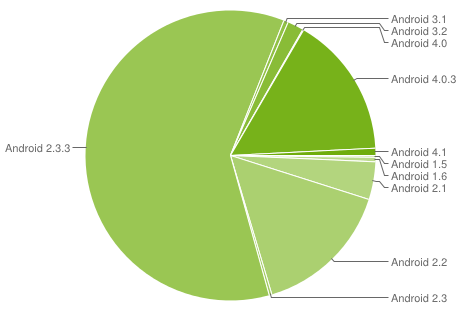
First, check the stats for Android OS adoption. There is a great Android dashboard that gives the top OS version hitting the Google play store for that 14-day period.   At the time of this blog, the Gingerbread 2.3.3 version has a little over 60% of the Android market share.


Understand the Device Market:
A recent study done by OpenSignalMaps did a great job of visualizing the Android device market fragmentation.  This information can quickly help narrow the devices to tailor your development and testing efforts.
Samsung and HTC are big players but the market share division gets ugly quickly.


Unfortunately, knowing the device maker is only half the battle.  The models and features of each model can vary greatly.  Getting down to the model level will help further refine your efforts.


Get the Right Testing Tools:
Purchasing physical devices to physically test your app on is ideal. But it gets costly and can be difficult to scale. To get breadth of testing, consider enlisting the support of testing tools and services such as DeviceAnywhere or Perfecto Mobile.  These services offer enterprise scale access to thousands of devices and OS versions.  This affords the ability to quickly test out how a feature performs and trouble shoot specific user issues. 

Capture App User Feedback:
The app store ratings is not where you want to first surface any issues with your app. To keep negative user reviews at bay, consider adding an in-app feedback mechanism.  This provides your users the opportunity to give candid feedback during the in-app experience and keeps the negative reviews out of the public eye.  Tools like OpinonLab give the customer a voice and help feed your product backlog as well as identify trends across user experience. 

Reassess Everything Quarterly:
As with anything in the mobile space, things change quickly.  Use the tools and information out there to  reassess where the Android market is and where you should be focused.


What are the strategies your company is using to keep pace with the demands of the Android market?

Friday, April 6, 2012

Why Your Business Needs a Mobile Website


While we anecdotally know that people are using smartphones more than ever these days there is real data that supports it. Studies have predicted that by 2014, more people will use mobile phones than PCs to get online.  If your business is just starting to develop a mobile strategy or if you are debating where to spend resources in your current strategy, here are some compelling reasons to continue to invest in the mobile web.


People search on mobile web, not in the app store.


We don't go to the app store looking for information.  We go there to find something specific- a game, a productivity tool, a mobile version of a service we are already using offline or in the desktop world.  We go to our browsers to do research and gather information. That coupled with our new behaviors means that people are more likely to be looking for your products and services on a mobile browser. 


If you have a mobile website, your site search feature should be considered one of the most if not THE most important feature.  It must be fast, contextual, and simple to use. Here are some interesting stats from a 2011mobile search study:
  • People used mobile search at home in the evening (81%) than any other time or places more frequently than anywhere else (81%), followed by at home on weekends (80%).
  • 66% use mobile search while while watching TV, something which should get advertisers thinking, while 61% said they use it at work.
  • 75% said mobile search makes their lives easier, 63% said access to mobile search has changed the way they gather information, and 32% said they use mobile search more than search engines on their computers. 
  • 84% use mobile search to look for information on local retailers, such as opening hours, address and contact details. 82% look for online retailers, 73% find a specific product or manufacturer website. 
  • Something which ties in with the crossover in TV viewing and mobile search is that 71% learn more about a product or service having seen an ad, 68% use it to find the best price for a product.

Consumer behaviorshave changed.
We are always on our phones.  When we have downtime, when we are in the middle of another activity, first thing in the morning, last thing before we fall asleep. With 66% of people using their smartphones while watching TV coupled with the results from an Internet Retailer study about what people are buying from their mobile devices (see below),  you could have some pretty compelling conversion rates between TV advertising and purchases.
 
A recent survey of 1,500 US adults at the 2011 Internet Retailer Conference Exhibition revealed mobile shoppers’ most common purchases broken down by percentage:

   16% bought apparel
   15% bought food and beverages
   11% bought toys and games
   8% bought home goods
   4% bought sporting goods
   3% bought jewelry
   8% bought all other product

Our fancy phones have also made us lazy.  We are more likely to make a purchase using the device already in our pocket than taking the effort involved to go to and boot up our desktop computer.  I can honestly say that I've made more mobile purchases in the last 6 months than from my desktop computer.  My drivers for mobile purchases are time & convenience.  With a 3 yr. old, a newborn, and a full-time career, the best time for me to shop is whenever I can steal a few minutes during my busy day - waiting in line, my train commute, in bed...
If you don't have a mobile site, or if your site is less than desirable, you will probably loose a potential customer.


People are going to try to find you via a mobile browser whether or not you are ready to be found. If you haven't put a mobile web version of your site out there yet, your desktop site will be rendered.  While chances are the site will load (if your site is flash based, forget reaching the millions of worldwide iPhone users) the user experience will suffer.  The mobile screen dimensions will require a lot of pinching and zooming to make the basic functions of your site useable.  Statistics show that a potential customer is more likely to seek out competitor with a mobile site than suffer through a poor mobile experience.  

Similarly, if your existing mobile website is difficult to use and slow, people will abandon it. Don't forget the best practices of mobile design - keep it simple and task oriented, design navigation for the thumb, keep the code lightweight and fast, use all the available phone senses (i.e. GPS, the camera) to make search fast and rewarding.

What are some mobile websites that you frequently use?  

Tuesday, January 10, 2012

Kindle Fire: The Gateway Tablet

It's no secret that I am a huge fan of my Apple products.  This holiday season I cheated on my iPad with my husband's new Kindle Fire.  To my surprise, I liked it.

There are several observations I made while using it.  First I'll start with opening the box:

1. The packaging - modeled after Apple's product packaging, there was very little else besides the tablet, a power cord, and a very small card with basic information.

2. It just worked - As soon as I took it out of the box I was able to power it on and immediately be productive. 

3. The user interface was intuitive - While not quite as slick as what I am used to on my iPad, the UI was surprisingly easy to navigate and it was easy to find what I was looking for.

4. Integration with my Amazon account - Being and Amazon product, the Fire makes it easy to make purchases via my existing Amazon account. Which had been dormant for a while but now that it's so easy to make purchases it's become my family's go to online retailer again.

This brings me to my point - the Kindle Fire isn't trying to be the next revelation in tablet technology.  It's a gateway to what Amazon does best - sells products.  Amazon isn't looking to make it's money on sales of the Fire, it's banking on the revenue it will rake in by making it even easier an more enjoyable to make purchases via the Amazon stores now accessible through the Fire. It's no surprise with it's sub $200 price tag that the Fire was the hottest selling item this holiday season.  It was the perfect gift - all the technical advancement of a tablet without the early adopter price tag.

In terms of market share, the Fire may have eaten into some of the iPad sales this season so much that speculation is that there is a $299 iPad on the horizon to help boost the dormancy in iPad sales.

So here are my predictions on what's next for the Kindle Fire:
1. The Fire will continue to dominate as a prime competitor to Apple's iPad in 2012.  Becoming the tablet of choice for those not willing to pay the Apple premium.
2. With it's size somewhere between that of a smartphone - not quite small enough to fit in your pocket -  and a tablet - not quite big enough for superior web browsing - Amazon will look to create a newer version that is larger and caters less to the Kindle loving reading crowd more to the tech savvy web browsing crowd.

You heard it here first folks - my predictions and analysis of the Kindle Fire tablet and how it's giving Apple a run for it's money.  What do you think?